Serenya
Role: Vampire tragedy figure, dark court-builder, immortal bride of the night
Affiliation: Bloodnight Court / Serenya’s private dominion
Era: Primarily Ätherzeit, with later echoes into Neon Nocturne interpretations
Associated Themes: forbidden love, hunger, power, sovereignty, seduction, loss, immortal consequence
Associated Songs: Queen of the Night, Velvet Hunger, Crown of Midnight, Rain-Sworn Mercy, Throne of Thirst, Crimson Echo, Black Bell Bride, Velvet Dominion, Neon Requiem
Canon Status: Song-first TeutaryaTeutarya is the dark-fantasy music and lore universe behind ... character profile
Overview
SerenyaSerenya is a vampiric key figure of Teutarya’s Song-First Ca... is one of the central dark figures of TeutaryaTeutarya is the dark-fantasy music and lore universe behind ....
She stands at the heart of the project’s vampire tragedy arc: beautiful, sorrowful, dangerous, and increasingly powerful. Her songs tell a story of love turned into curse, hunger turned into law, and grief reshaped into dominion.
She is not written as a simple monster.
SerenyaSerenya is a vampiric key figure of Teutarya’s Song-First Ca... is a tragedy that learned to rule.
Her arc moves through seduction, loss, sacrifice, self-coronation, and the slow building of a dark court beneath a greater crown. She is both victim and threat, both wounded soul and commanding presence.
In the music of TeutaryaTeutarya is the dark-fantasy music and lore universe behind ..., she becomes one of the clearest examples of how beauty and darkness can exist in the same figure without cancelling each other out.
Who Is Serenya?
SerenyaSerenya is a vampiric key figure of Teutarya’s Song-First Ca... begins as a woman caught in a moment where love and doom become impossible to separate.
Her origin tragedy is told through the atmosphere of rain, moonlight, empty streets, fatal intimacy, and the first shadowShadow is the Aether aspect of rupture, hunger, secrecy, dec... of the Bloodnight Court. A wedding night becomes a curse. A kiss becomes a threshold. A vow becomes something that continues burning long after mortal life has ended.
From that beginning, Serenya’s story does not remain passive.
She changes.
She suffers.
She desires.
She claims.
Across the songs, SerenyaSerenya is a vampiric key figure of Teutarya’s Song-First Ca... evolves from cursed bride into a figure of command. The hunger that once marked her damnation becomes discipline. The sorrow that once defined her becomes part of her authority. The night no longer only takes from her — she begins to shape it.
That transformation is what makes her one of Teutarya’s most important characters.
Role in Teutarya
SerenyaSerenya is a vampiric key figure of Teutarya’s Song-First Ca... represents the gothic-vampiric side of TeutaryaTeutarya is the dark-fantasy music and lore universe behind ...: dark romance, aristocratic shadowShadow is the Aether aspect of rupture, hunger, secrecy, dec..., immortal sorrow, dangerous beauty, and the cost of desire.
Where the Order of the Lighttest More embodies resistance, duty, and sacred courage, SerenyaSerenya is a vampiric key figure of Teutarya’s Song-First Ca... embodies a very different kind of power: intimate, seductive, controlled, and morally dangerous.
Her presence opens a door into Teutarya’s darker courtly world:
- vampire hierarchy
- blood-bound vows
- aristocratic decadence
- forbidden intimacy
- beauty as command
- hunger as law
- immortality as both gift and prison
She is also one of the strongest bridges between TeutaryaTeutarya is the dark-fantasy music and lore universe behind ... as music and TeutaryaTeutarya is the dark-fantasy music and lore universe behind ... as lore.
The songs do not function as songs performed inside the world itself. They are artistic interpretations of the world, designed to feel like fragments of a larger myth. This matches the wider TeutaryaTeutarya is the dark-fantasy music and lore universe behind ... structure: music-first, but connected to lore, visuals, and chroniclesThe Chronicles are written fragments, lore entries, characte.... :contentReference[oaicite:0]{index=0}
The Serenya Arc
Serenya’s arc can be read in several phases.
Phase I — The Cursed Bride

This is the beginning of Serenya’s tragedy.
In Queen of the Night, her story begins with romantic darkness: rain, moonlight, empty streets, and the fatal intimacy of a kiss that changes everything. The night does not simply kill her old life. It transforms it.
This phase is defined by:
- doomed love
- cursed intimacy
- the wedding-night motif
- the first pull of the Bloodnight Court
- the loss of ordinary human future
Serenya’s tragedy begins not with war, but with closeness.
That makes the fall more personal.
Phase II — Hunger and Pact
In songs like Velvet Hunger and Rain-Sworn Mercy, Serenya’s vampire tragedy becomes more complex.
The hunger is not only monstrous. It is tied to mercy, sacrifice, desire, and the attempt to turn death aside. But TeutaryaTeutarya is the dark-fantasy music and lore universe behind ... rarely allows mercy to remain pure. A pact may save one life while binding another to something eternal.
This phase is defined by:
- vampire pact
- immortality at a cost
- desire becoming obligation
- mercy becoming possession
- intimacy becoming consequence
SerenyaSerenya is a vampiric key figure of Teutarya’s Song-First Ca... is not merely taking power here.
She is learning what power costs.
Phase III — Midnight Devotion

Crown of Midnight shows SerenyaSerenya is a vampiric key figure of Teutarya’s Song-First Ca... as a figure of fatal attraction.
Here, devotion and sacrifice become almost indistinguishable. Love bends toward ritual. Desire becomes surrender. The night does not simply surround her — it answers her.
This phase is defined by:
- midnight symbolism
- dark romance
- ritual desire
- fatal devotion
- love becoming sacrifice
The tragedy is no longer only what happened to SerenyaSerenya is a vampiric key figure of Teutarya’s Song-First Ca....
It becomes what happens around her.
Phase IV — Self-Coronation
Throne of Thirst and Crimson Echo mark a major transformation.
SerenyaSerenya is a vampiric key figure of Teutarya’s Song-First Ca... stops being only the woman cursed by the night. She begins to claim the night as law. A frightened figure becomes sovereign. Hunger, once a curse, becomes discipline. Her tragedy hardens into authority.
This is one of the strongest turning points in her arc.
She does not become free in a clean heroic sense.
Instead, she becomes powerful enough that no one can command her easily.
This phase is defined by:
- self-coronation
- sovereignty
- hunger as law
- no way back
- tragic rule
- dominion born from consequence
Serenya’s power does not erase her wound.
It gives the wound a throne.
Phase V — The Immortal Kiss
In Black Bell Bride, SerenyaSerenya is a vampiric key figure of Teutarya’s Song-First Ca... steps into a more active and fatal role.
She no longer waits for fate. She chooses. She moves through the night as a promise and a threat. The immortal kiss becomes her instrument: beautiful, intimate, and irreversible.
This phase is defined by:
- immortal kiss
- fatal longing
- controlled seduction
- beauty as danger
- love becoming a vow
The word “bride” still carries the memory of her beginning. But now, the image has changed.
She is no longer only the bride taken by the night.
She has become the night’s answer.
Phase VI — Private Dominion

Velvet Dominion expands SerenyaSerenya is a vampiric key figure of Teutarya’s Song-First Ca... beyond the individual tragedy.
Here, she begins to build a private court of her own: attendants, whispered commands, controlled elegance, and dangerous loyalty. She is no longer just a singular vampire figure. She becomes the center of a hierarchy.
But this power remains layered.
Above her still stands AlthéaAlthéa is the later Vampire Queen and a founding figure of t..., the higher queen of the Bloodnight Court.
That tension is important. Serenya’s rise is real, but not absolute. Her dominion exists beneath a greater crown, which creates space for future conflict, ambition, loyalty, and betrayal.
This phase is defined by:
- inner court
- hierarchy
- loyalty
- obedience
- ambition
- political darkness
- power beneath a higher queen
Serenya’s tragedy has become political.
Phase VII — Neon Echoes
Neon Requiem moves Serenya’s emotional language into a more modern, neo-noir atmosphere.
Here, the vampire tragedy is no longer framed only by ancient halls, rain-soaked gothic streets, or courtly darkness. It can also appear beneath neon lightLight is the Aether aspect of binding, order, oath, protecti..., in nocturnal cities, where immortality feels less like a myth and more like a prison that never ends.
This phase is defined by:
- neon sorrow
- immortal memory
- urban gothic atmosphere
- endless night in modern form
- beauty beneath artificial lightLight is the Aether aspect of binding, order, oath, protecti...
The tragedy survives the era shift.
It changes its face.
Personality and Presence
SerenyaSerenya is a vampiric key figure of Teutarya’s Song-First Ca... is defined by contrast.
She is seductive, but not careless.
She is sorrowful, but not weak.
She is dangerous, but not mindless.
She is beautiful, but beauty alone does not explain her power.
Her presence should feel controlled, elegant, and emotionally loaded. She does not need to shout to dominate a scene. Her authority is quiet, intimate, and cold enough to make others lean closer before realizing the danger.
Key personality traits:
- composed
- wounded
- seductive
- intelligent
- fatal
- proud
- emotionally restrained
- increasingly sovereign
- capable of tenderness, but never safely
SerenyaSerenya is a vampiric key figure of Teutarya’s Song-First Ca... is strongest when she feels like someone who remembers what she lost — and has decided to make the world pay attention to what she became.
Visual Identity

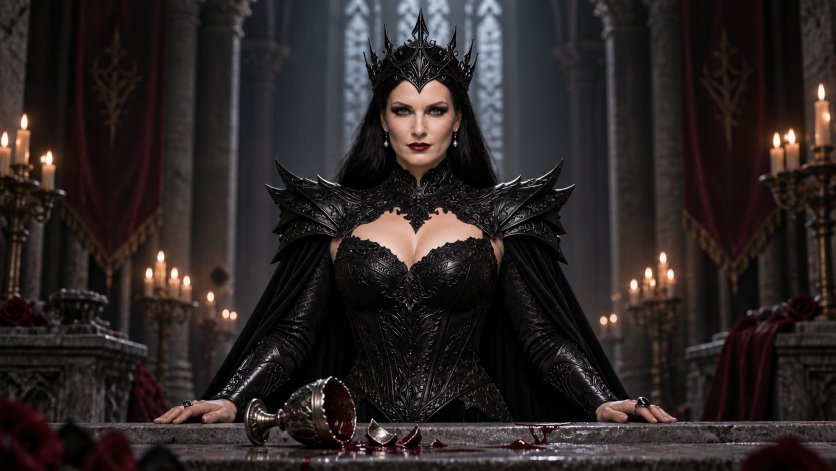
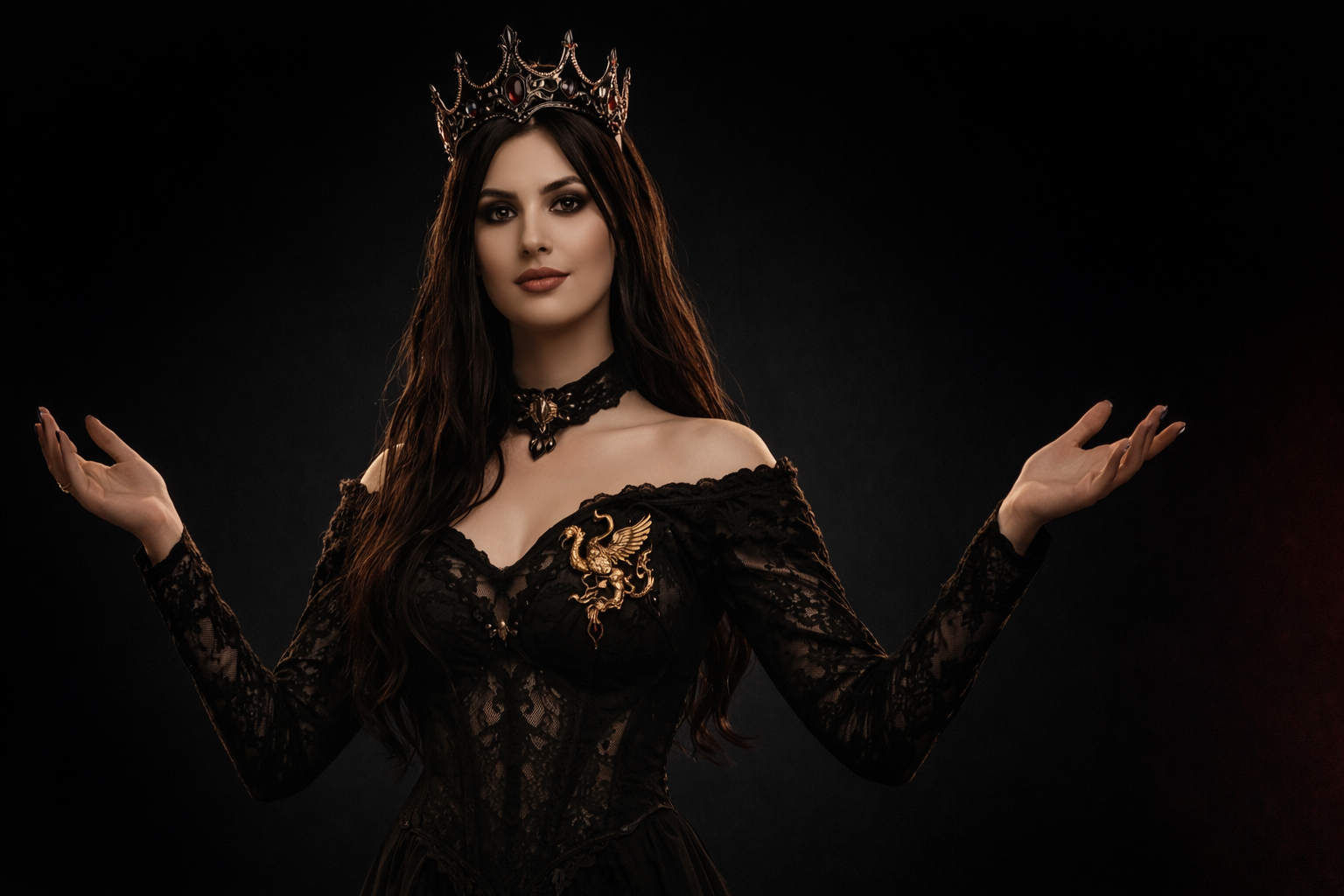
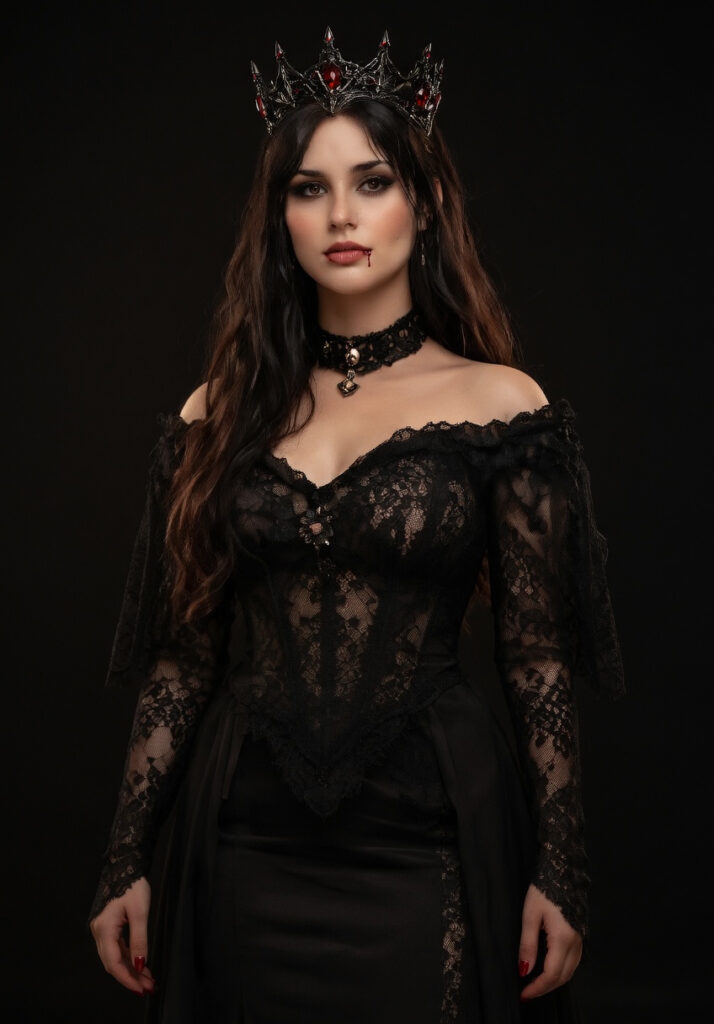
Serenya’s visual identity should feel gothic, aristocratic, tragic, and dangerous.
She is not a savage vampire creature. She is closer to a dark court figure: elegant, controlled, beautiful, and touched by sorrow.
Core visual motifs:
- black, crimson, and deep velvet tones
- pale moonlit skin
- rain, night, candlelight, or neon glow depending on era
- elegant gothic dresses or dark court attire
- crown, veilThe Veil is the mystical boundary between worlds, realms, or..., or bridal echoes
- subtle blood symbolism
- restrained aristocratic posture
- eyes that suggest both longing and command
For older gothic scenes, SerenyaSerenya is a vampiric key figure of Teutarya’s Song-First Ca... should feel tied to moonlight, stone, rain, and candlelit interiors.
For Neon Nocturne interpretations, she may appear in a more modern nocturnal environment, but the core should remain: elegance, sorrow, hunger, and control.
Symbols and Motifs
The Crown
The crown represents Serenya’s transformation from victim to ruler.
It is not simply decoration. It marks the moment where hunger becomes authority.
Velvet
Velvet is one of Serenya’s strongest recurring textures.
It suggests softness, intimacy, luxury, and aristocratic beauty — but in her arc, velvet often hides command, hunger, and consequence.
The Kiss
The kiss is one of Serenya’s most dangerous motifs.
It is love, pact, surrender, and transformation at once. In her story, intimacy is never harmless.
The Bell
The bell carries the feeling of ritual, mourning, and finality.
In Black Bell Bride, it suggests that desire can become a funeral vow before the victim understands what has happened.
Rain and Moonlight
Rain and moonlight belong to Serenya’s origin tragedy.
They frame her not only as vampire, but as sorrow made visible.
Neon
In later interpretations, neon becomes the modern equivalent of moonlight: beautiful, cold, artificial, and unable to warm the immortal soul beneath it.
Relationship to the Bloodnight Court
SerenyaSerenya is a vampiric key figure of Teutarya’s Song-First Ca... is tied to the Bloodnight Court, but she should not be reduced to a simple servant of it.
Her arc increasingly points toward her own power base.
The Court offers structure, hierarchy, and a language for the darkness she has entered. But Serenya’s personal tragedy and growing authority make her more than a decorative court figure.
Her relationship to the Bloodnight Court should feel layered:
- she belongs to its darkness
- she learns from its hierarchy
- she benefits from its order
- she is constrained by its higher powers
- she begins building something of her own within it
This is especially important in relation to AlthéaAlthéa is the later Vampire Queen and a founding figure of t....
AlthéaAlthéa is the later Vampire Queen and a founding figure of t... remains the higher queen above SerenyaSerenya is a vampiric key figure of Teutarya’s Song-First Ca... in the current song-first arc. Serenya’s dominion grows beneath that crown, creating tension between loyalty, ambition, and future conflict.
Relationship to Althéa

AlthéaAlthéa is the later Vampire Queen and a founding figure of t... is the greater queenly force above Serenya’s rising dominion.
This makes their relationship one of the most interesting future pressure points in the vampire side of TeutaryaTeutarya is the dark-fantasy music and lore universe behind ....
SerenyaSerenya is a vampiric key figure of Teutarya’s Song-First Ca... may build a private court, but she does not yet stand above the entire Bloodnight hierarchy. Her ambition must therefore move through shadowShadow is the Aether aspect of rupture, hunger, secrecy, dec..., loyalty, performance, and patience.
Possible tensions between SerenyaSerenya is a vampiric key figure of Teutarya’s Song-First Ca... and AlthéaAlthéa is the later Vampire Queen and a founding figure of t...:
- private dominion versus established crown
- personal loyalty versus hidden ambition
- beauty as influence versus queenly authority
- inner court versus Bloodnight Court
- tragic self-rule beneath a greater sovereign
This dynamic should not be flattened into simple rivalry too early.
It is more powerful as tension.
Related Songs
Queen of the Night
Serenya’s origin tragedy: wedding night, curse, fatal kiss, and the first shadowShadow is the Aether aspect of rupture, hunger, secrecy, dec... of the Bloodnight Court.
Velvet Hunger
A vampire pact shaped by sacrifice, hunger, and the terrible cost of turning death aside.
Crown of Midnight
A dark romantic song of midnight devotion, fatal attraction, and love becoming sacrifice.
Rain-Sworn Mercy
Immortality as transaction, mercy as binding, and the seduction of eternal life.
Throne of Thirst
Serenya’s sovereignty song: hunger becomes law, and no one commands her now.
Crimson Echo (Final Oath)
A major turning point where self-coronation, dominion, and tragic power converge.
Black Bell Bride
SerenyaSerenya is a vampiric key figure of Teutarya’s Song-First Ca... becomes more active and fatal: the immortal kiss turns longing into surrender.
Velvet Dominion
SerenyaSerenya is a vampiric key figure of Teutarya’s Song-First Ca... begins building her own dark court beneath Althéa’s greater crown.
Neon Requiem
A neo-noir echo of vampire tragedy, where ancient sorrow survives beneath modern night.
Related Characters
- AlthéaAlthéa is the later Vampire Queen and a founding figure of t... — higher queen of the Bloodnight Court and a major power above Serenya’s rising dominion.
- Jarek — Bloodwarden / Blood Guardian figure connected to the darker courtly side of TeutaryaTeutarya is the dark-fantasy music and lore universe behind ....
- Lady Veyra — Bloodnight noblewoman, useful for expanding court intrigue and aristocratic vampire politics.
- Unnamed victims, lovers, attendants, and chosen figures — Serenya’s arc often turns intimacy into consequence.
Related Factions
Bloodnight Court
The aristocratic vampire court connected to hierarchy, blood, dominion, beauty, and controlled darkness.
Serenya’s Private Dominion
A growing inner court beneath the greater Bloodnight crown. This is not necessarily a formal faction yet, but it is becoming a distinct power structure in the song-first arc.
Themes
Love as Consequence
In Serenya’s story, love is never only comfort. It can save, bind, destroy, or transform.
Hunger as Law
Her hunger begins as curse, but later becomes discipline and authority.
Beauty as Danger
Serenya’s beauty is not passive. It draws others in and becomes part of her power.
Immortality as Prison
Eternal life in Serenya’s arc is not simple victory. It is memory without release.
Sovereignty Through Tragedy
SerenyaSerenya is a vampiric key figure of Teutarya’s Song-First Ca... does not rise because she is untouched by pain. She rises because pain becomes the foundation of her rule.
Notes for New Visitors
SerenyaSerenya is a vampiric key figure of Teutarya’s Song-First Ca... is one of the best entry points into Teutarya’s darker side.
If you are new to the project, her arc shows how TeutaryaTeutarya is the dark-fantasy music and lore universe behind ... uses songs as emotional windows into a larger world. You do not need to know the full lore before listening. The music comes first, and the lore grows around it.
A good listening path:
- Queen of the Night
- Velvet Hunger
- Crown of Midnight
- Rain-Sworn Mercy
- Throne of Thirst
- Crimson Echo
- Black Bell Bride
- Velvet Dominion
- Neon Requiem
This order is not a strict canon timeline, but it gives a strong emotional progression through Serenya’s vampire tragedy.
Behind the Character
SerenyaSerenya is a vampiric key figure of Teutarya’s Song-First Ca... works because she sits between several powerful gothic ideas:
- the cursed bride
- the vampire queen
- the tragic lover
- the immortal prisoner
- the dangerous seductress
- the court-builder
- the sovereign born from grief
She is not only a character for one song.
She is a recurring emotional axis for Teutarya’s vampire material.
Her story allows the project to explore dark romance without making it harmless, power without making it clean, and beauty without removing danger.
Explore More
- Queen of the Night
- Velvet Hunger
- Crown of Midnight
- Rain-Sworn Mercy
- Throne of Thirst
- Crimson Echo
- Black Bell Bride
- Velvet Dominion
- Neon Requiem