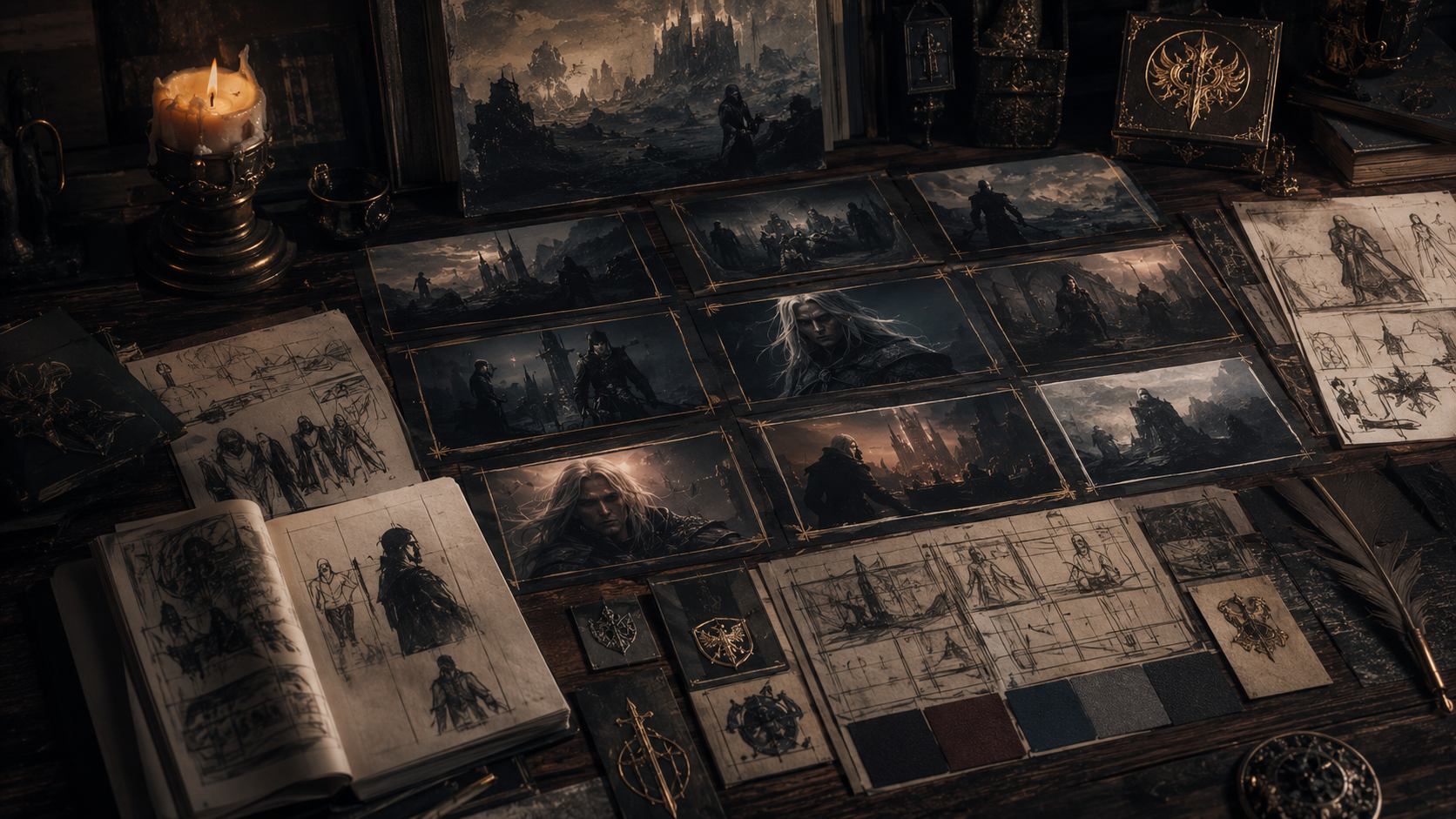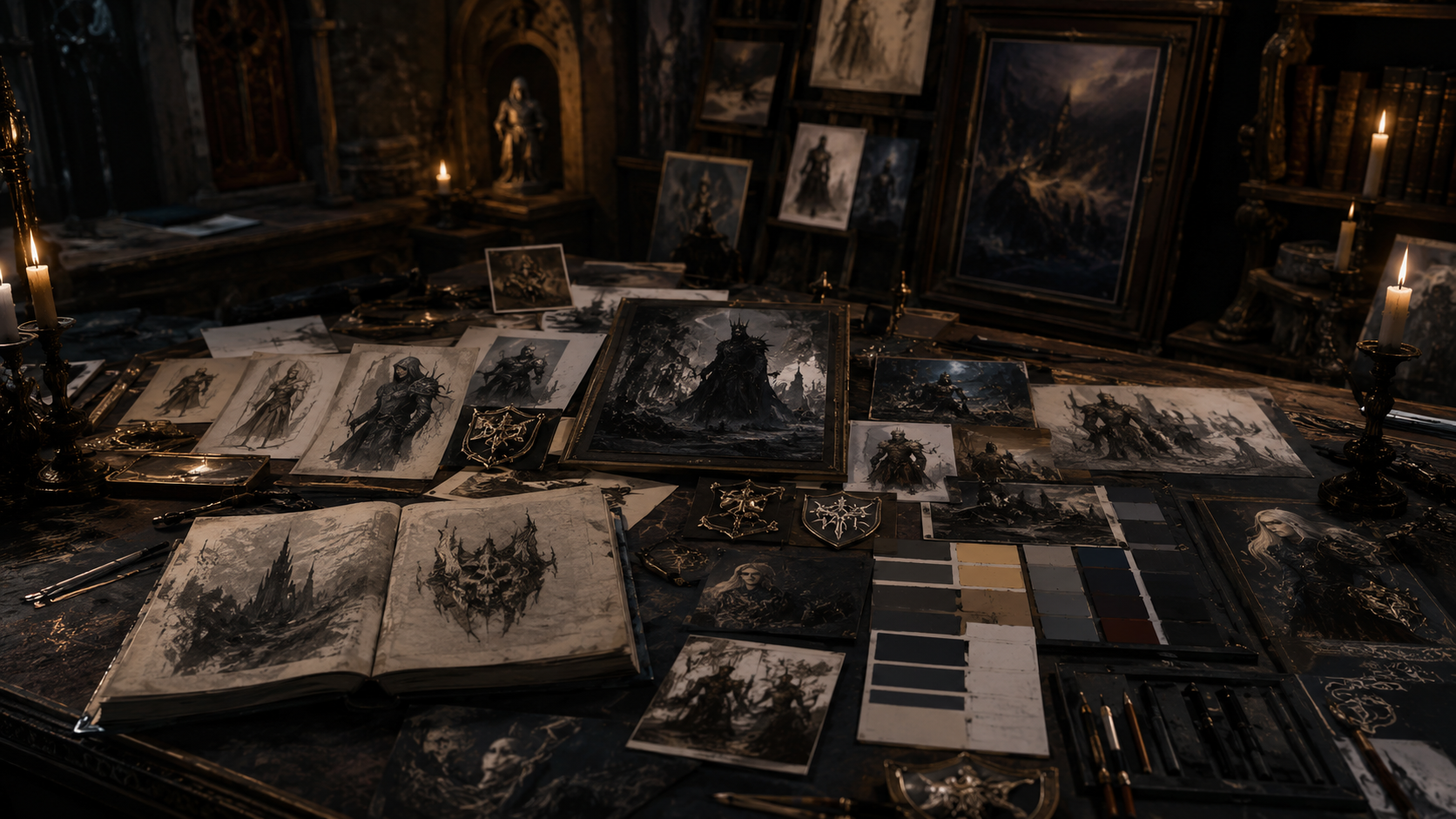
A song can place an entire city inside a frozen hour. A story must also make us care about the person standing outside it.
That is one of the central challenges in developing “Chronos in Chains” as an audiobook story. The song gives us suspended time, endurance and protection that has become imprisonment. The prose follows Aren Valdren as he searches for the vanished city of his ancestors—and reaches the point where believing his family means taking a risk.
This is a look inside the developing German manuscript. The audiobook is still in development.
What the song already carries
The lyrics surround the listener with a world that cannot finish its own movements: silent bells, frozen streets and a century held within an hour. Shelter has become something unbearable.
Music can return to that condition through a chorus. Repetition lets the same image gather weight as the song continues.
For a narrated scene, that emotional center needs a sequence of discoveries. Someone must notice a trace, decide whether to trust it and act on what it suggests.
Give the search a personal cost
In the current manuscript, Aren begins beside an abandoned road, scraping lichen from a stone. His knees are wet, his fingers are cold, and he has already promised himself that he will stop searching.
He carries family records describing a griffin marker. The vanished city is called Eidwacht in this German text. Its memory has passed down through his family, while the Order’s archives have treated the account as a likely confusion with another place.
Aren has once used that same explanation himself. His mother’s quiet response stays with him.
The search now carries something he cannot settle by finding an interesting ruin. He must face the possibility that his family was right—and remember how easily he dismissed them.
From an image to a sequence
The change of scale is visible in one small moment from the German draft:
Unter den Flechten erschien ein Schnabel.
A beak appears beneath the lichen. The discovery gives Aren something specific to recognize. He clears the stone, compares the griffin to the family drawing and looks toward a valley that still appears empty.
The scene can then build toward revelation. He tests the inherited sealA Seal is a ritual or magical binding used to close, dampen,... against the marker. His attention slips away from the place he is trying to examine. Only gradually does he understand that the city is hidden from more than ordinary sight.
This is an editorial summary of the German scene, not an excerpt from an English audiobook edition.
Write for a listener’s attention
The manuscript follows Aren closely enough that each new sensation arrives with his uncertainty. The listener can discover the place alongside him.
That approach also makes physical continuity matter. If he uses a knife, puts it down and later crosses a boundary, the text needs to keep track of it. A small action can prevent a distracting question at the moment the scene needs attention most.
The planned telling uses one narrator, with LyrenorLyrenor is a time-crossing bard and chronicler who gathers T... framing the story. Pauses and delivery will still need to be heard and judged in the audio itself.
What remains ahead
The current German manuscript contains three episodes. Listening review and audio approval remain ahead, and an English audiobook version has not yet been prepared.
For now, the opening shows what adaptation can add: a person with cold hands, a family memory he has doubted, and one mark beneath the lichen that makes turning back harder.
The frozen hour gives the story its impossible situation. Aren’s next choice gives us a reason to follow it.