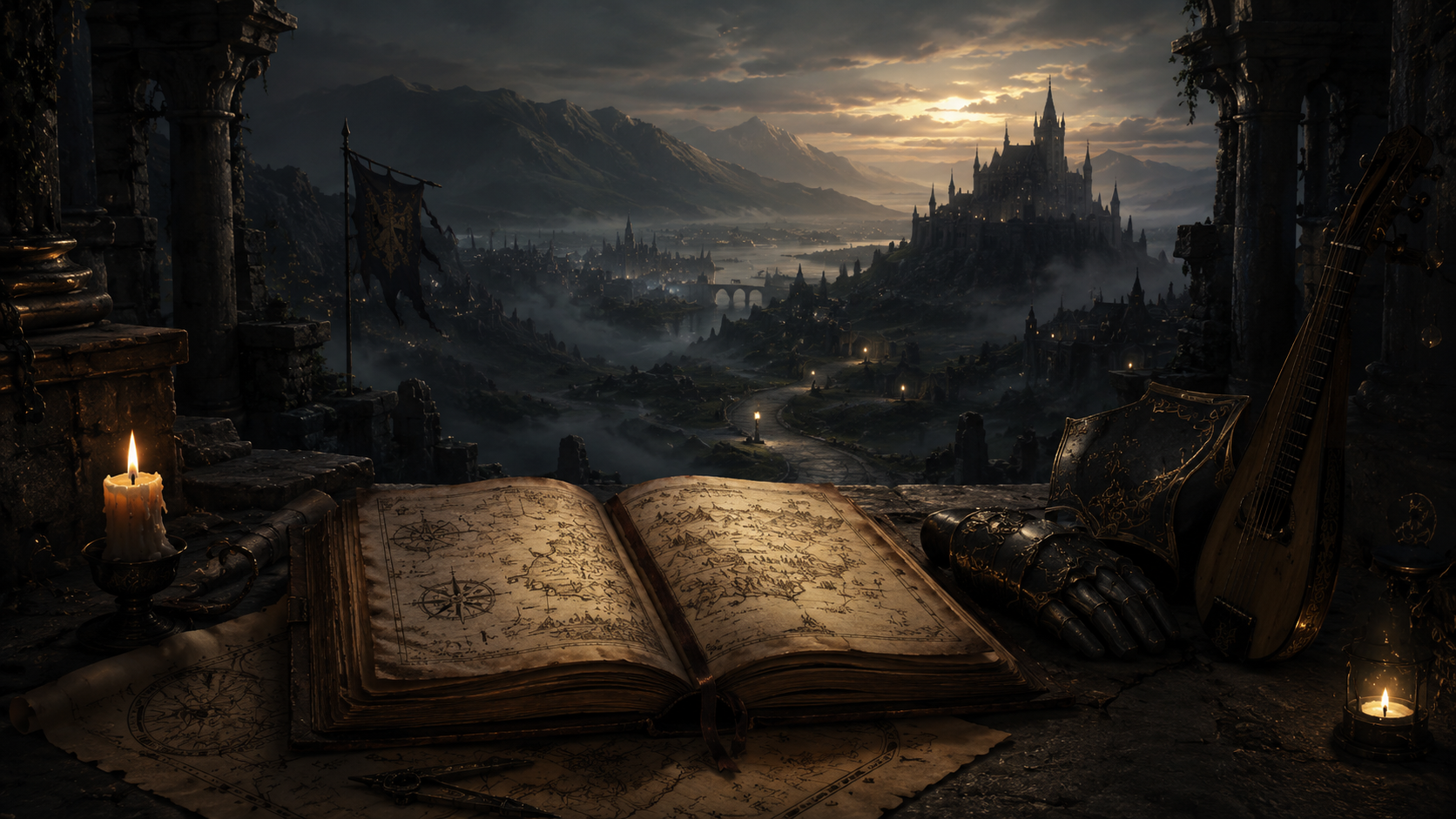
MarvalisMarvalis is a major city of wet stone, mist, towers, alleys,... is a city you can approach by sea—or discover one concealed doorway at a time.
Its established place in TeutaryaTeutarya is the dark-fantasy music and lore universe behind ... is clear: a great harbor city and the political center of Velmorien. In “Queen of the Night,” that public world gives way to a more intimate experience of the city, as SerenyaSerenya is a vampiric key figure of Teutarya’s Song-First Ca... follows others beneath its streets and learns how little she understands of the place around her.
This guide begins with the city’s established geography, then turns to its portrayal in the chronicle.
Begin at the harbor
MarvalisMarvalis is a major city of wet stone, mist, towers, alleys,... connects trade, shipyards and sea routes. Supply by sea is part of its importance, alongside the economic and alliance power associated with its position.
The harbor gives the city a practical foundation. Ships must be built and supplied; goods and people must arrive somewhere. MarvalisMarvalis is a major city of wet stone, mist, towers, alleys,... has a place in the wider world before any individual character enters its shadows.
Its role as Velmorien’s political center adds another reason to pay attention. The city sits where material needs and decisions about power meet. That is a useful starting point for reading its stories, even where the details of its streets remain undescribed.
Follow the sound underground
Chapter IV of “Queen of the Night,” “Beneath MarvalisMarvalis is a major city of wet stone, mist, towers, alleys,...,” offers a very different route through the city.
SerenyaSerenya is a vampiric key figure of Teutarya’s Song-First Ca... follows Myris through a twisting tunnel, with Nera close behind. Damp stone, salt in the air and the diminishing sound of the harbor tell the reader that the surroundings are changing. The chapter lets us experience the journey through Serenya’s newly altered senses.
The harbor grows faint overhead. Another rhythm takes its place: masonry trembling above water. Distance is felt through sound before it is explained through geography.
These are details of the chronicle’s scene, rather than instructions for a complete map of MarvalisMarvalis is a major city of wet stone, mist, towers, alleys,....
A door that requires a guide
Myris opens a concealed section of wall. Beyond it stands a black wooden door with no sign.
Inside, narrow passages, heavy beams and muted lamps create a place that SerenyaSerenya is a vampiric key figure of Teutarya’s Song-First Ca... could not easily navigate alone. Her dependence on her guides becomes part of the tension. They know where to go, what to touch and which questions can wait.
As a reading of the scene, the architecture makes power tangible. Access belongs to those who already understand the house. SerenyaSerenya is a vampiric key figure of Teutarya’s Song-First Ca... must learn its rules while standing inside it.
When a name becomes a question
The encounter with Valen, the scribe and chamber attendant, turns that uncertainty toward SerenyaSerenya is a vampiric key figure of Teutarya’s Song-First Ca... herself. His remarks about names introduce the possibility that entering the night’s social order may change how she is known.
For the reader, this is a shift from finding shelter to wondering what shelter will require. A closed door can offer relief while placing someone within another person’s rules.
That tension gives this portrayal of MarvalisMarvalis is a major city of wet stone, mist, towers, alleys,... much of its pull. The city offers places to enter long before it offers certainty about belonging.
Where to begin reading
Start “Queen of the Night” from its opening if you want to follow Serenya’s arrival in this world. Return to “Beneath Marvalis” to notice how sound, movement and small restrictions build the city around her.
The established harbor and the chronicle’s hidden rooms provide two useful perspectives: MarvalisMarvalis is a major city of wet stone, mist, towers, alleys,... as a place that connects a region, and MarvalisMarvalis is a major city of wet stone, mist, towers, alleys,... as a place one person must learn to survive.